
The ellipse
The ellipse is defined as the set of points in the plane such that the sum of the distances from the point to two fixed points called foci is constant. The midpoint between the foci is called the center and the distance from the center to either focus is denoted by \(c\) and is called the focal distance. The mean distance from the two foci to any point on the ellipse is called \(a\), and \(2a\) is the maximum possible distance between two points on the ellipse. These two parameters, \(a\) and \(c\), completely characterize the ellipse.
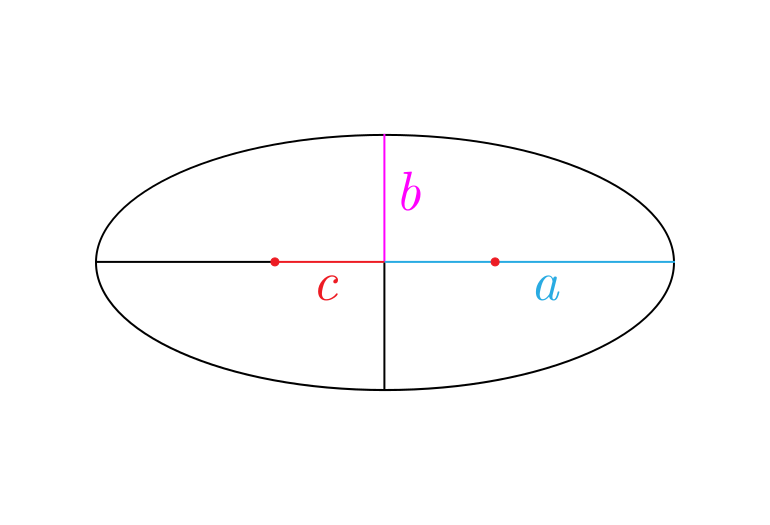
The ellipse has been defined geometrically, but we need an analytic representation of it, i.e., an equation that describes the ellipse.
To find an equation for the ellipse we need a coordinate system. The coordinate system that is useful in the two-body problem is the polar coordinate system with the origin at one of the foci of the ellipse. The polar coordinates will be \(r\) measured from the origin, and \(\theta\) measured from an arbitrary straight line that starts at the origin.
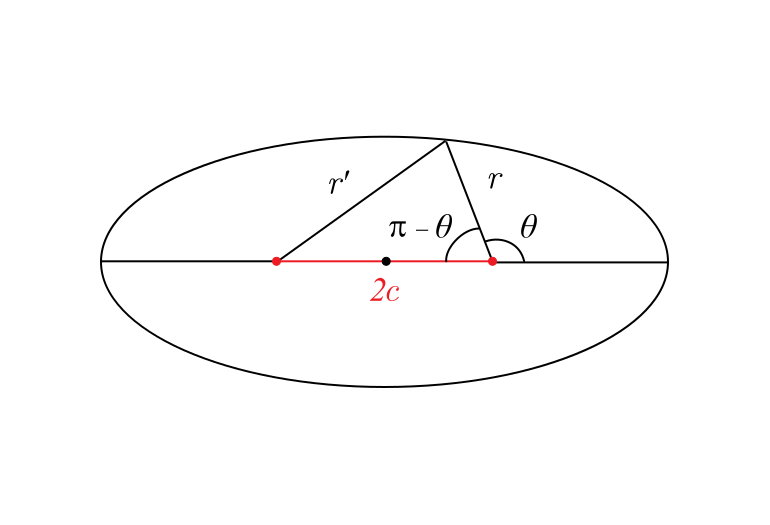
According to the definition we have
\begin{equation}
r+r^{\prime}=2a\ .
\end{equation}
Now we can use the cosine theorem to express \(r^{\prime}\) in terms of \(r\) and \(c\):
\begin{equation}
r^{\prime\ 2}=(2c)^2+r^2-2(2c)r\cos(\pi-\theta)
\end{equation}
The combination of the two preceding equations leads us to
\begin{equation}
(2a-r)^2=4c^2+r^2+4cr\cos\theta\ ,
\end{equation}
and after simplification we get
\begin{equation}
r=\frac{a\left(1-\frac{c^2}{a^2}\right)}{1+\frac{c}{a}\cos\theta}
\end{equation}
The ratio \(\varepsilon=c/a\) is called the eccentricity of the ellipse. From the definition of the ellipse we see that \(0\leq\varepsilon<1\). The value \(\varepsilon=0\) corresponds to the case when the two foci are located at the center and therefore the ellipse is just a circle. The eccentricity is a more useful parameter than the focal distance \(c\). In terms of the eccentricity, the polar equation of the ellipse is
\begin{equation}
\boxed{
r=\frac{a(1-\varepsilon^2)}{1+\varepsilon\cos\theta}}
\end{equation}
Important relations
The nearest point on the ellipse to the focus is denoted \(r_-\), and the farthest one \(r_+\). Those correspond to \(\theta=0\) and \(\theta=\pi\) respectively:
\begin{equation}
r_-=\frac{a(1-\varepsilon^2)}{1+\varepsilon}=a(1-\varepsilon)\ ,
\end{equation}
\begin{equation}
r_+=\frac{a(1-\varepsilon^2)}{1-\varepsilon}=a(1+\varepsilon)\ .
\end{equation}
These relation express \(r_-\) and \(r_+\) in terms of \(a\) and \(\varepsilon\). We can invert these relations to express \(a\) and the eccentricity \(\epsilon\) in terms of \(r_-\) and \(r_+\):
\begin{equation}
\varepsilon=\frac{r_+-r_-}{r_++r_-}\ ,
\end{equation}
\begin{equation}
a=\frac{r_++r_-}{2}\ .
\end{equation}